Military secrecy policy
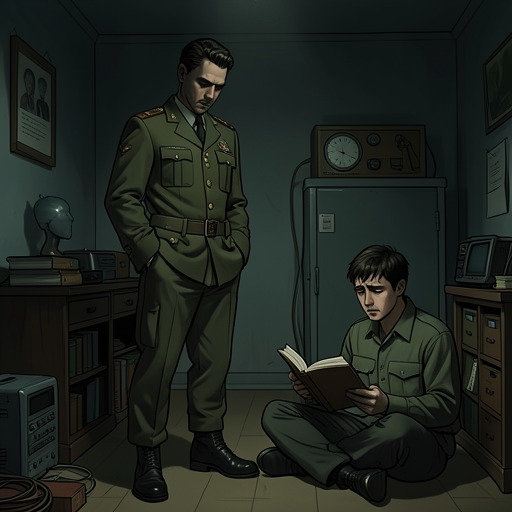
Here There Is No WhyThe military secrecy policy is presented not as a clearly defined written code but as a claimed duty to keep details of service confidential. Through Charlie, that duty shifts between banter and genuine withholding: he freely hints at his assignments, yet later insists that the location and date of a lethal incident cannot be disclosed. The contrast gives secrecy both a comic surface and serious consequences for what can be known about wartime violence.
The Rule in Ordinary Service
Charlie introduces military secrecy to Judah Loeb while preparing for his first reserve duty. As he takes apart and cleans his rifle, he says he cannot tell Judah where he will be sent, then gives away that the patrol will be near Bethlehem. The disclosure is immediately softened as a joke, and the episode leaves Judah uncertain whether Charlie’s service really involved confidential information or whether Charlie was simply poor at keeping it.
That uncertainty becomes part of the rule’s characterization. Charlie repeatedly begins army stories by warning that he is not allowed to discuss them, although during their first month together these stories are nearly all he wants to talk about. Secrecy is therefore not shown as an absolute silence: Charlie lets fragments through, and his warning becomes a familiar preface that blurs the line between genuine restriction and playful performance.
Assignments and the Limits of the Claim
Charlie says he would find a way to avoid serving in Lebanon. When the Israel Defense Forces invade Southern Lebanon, however, his unit’s movements are described in concrete terms: it spends a week training with new weapons in the Negev, then patrols Ramallah and Nablus. Charlie never faces combat during his service and is discharged at twenty-one, three years after joining.
These details provide a contrast to his earlier secrecy claims. The narrative can recount the broad sequence of his service while preserving the uncertainty and teasing tone surrounding what Charlie was supposedly forbidden to say. His Bethlehem hint is specific enough to make the rule visible, but not presented as proof of what formal restrictions applied or how they were enforced.
Secrecy and the Later Account of Violence
Years later, Charlie recounts a lethal encounter in Lebanon while withholding its exact time and place, saying that he cannot identify either. He describes an attack that begins with stones thrown by children and then shifts to live fire. According to his account, his commander orders the unit to return fire; Charlie says that he fires two bursts at what he believes are armed fighters, only to discover that the targets are two unarmed ten-year-old boys.
The withheld location and date limit the account’s verifiability within the narrative, while Charlie’s detailed description makes the moral stakes unmistakable. He links the incident to his father’s death, claiming that the killing of the boys was what his father could not live with. Secrecy thus coexists with disclosure: Charlie conceals identifying particulars while revealing the central act and its claimed consequence.
Narrative Function
The policy’s significance lies in this tension rather than in any explanation of military procedure. Early on, Charlie’s loose talk makes confidentiality seem porous and even comic. In the later account, the refusal to name where and when the shooting occurred marks a boundary around the story precisely when accountability and memory become central. The novel does not establish the formal scope of the policy; it shows how the language of secrecy can accompany both casual storytelling and a consequential, partially unlocatable account of violence.